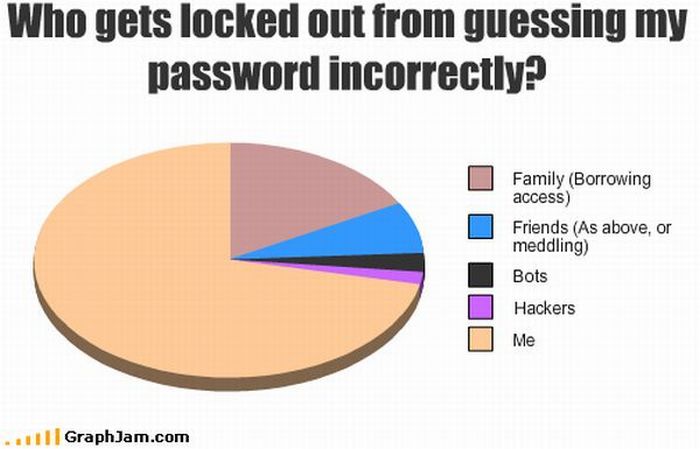
Social Priorities are minorities ;-)


SlashDot - "The HoneyGrid scans 40 million Web sites and 10 million emails, so it was bound to find something interesting. Among the things it found was that a staggering 95% of User Generated Content is either malicious in nature or spam." Here is the report's front door; to read the actual report you'll have to give up name, rank, and serial number.
Here are the key findings: (via daniweb.com)
* 13.7% of searches for trending news/buzz words (as defined by Yahoo Buzz & Google Trends) led to malware.
* The second half of 2009 revealed a 3.3% decline in the growth of malicious Web sites compared to the first half of the year. Websense Security Labs believes this is due to the increased focus on Web 2.0 properties with higher traffic and multiple pages.
* However, comparing the second half of 2009 with the same period in 2008, Websense Security labs saw an average of 225% growth in malicious Web sites.
* 71% of Web sites with malicious code are legitimate sites that have been compromised.
* 95% of user-generated posts on Web sites are spam or malicious.
* Consistent with previous years, 51% of malware still connects to host Web sites registered in the United States.
* China remains second most popular malware hosting country with 17%, but during the last six months Spain jumped into the third place with 15.7% despite never having been in the top 5 countries before.
* 81% of emails during the second half of the year contained a malicious link.
* Websense Security Labs identified that 85.8% of all emails were spam.
* Statistics for the second half of 2009 show spam emails broke down as 72% (HTML), 11.2% (image), 14.4% (plain text with URL) and 2.4% (plain text with no URL).
* 35% of malicious Web-based attacks included data-stealing code.
* 58% of all data-stealing attacks are conducted over the Web.
I believe we are at a level of technology and mind mapping to utilize digital interfaces that can enhance this potential... but we are a little busy playing games on our iPhone ;-)
Source: Psychological Science
Setting humans apart from other species is the ability to travel subjectively through time (Suddendorf & Corballis, 2007), a process termed chronesthesia (Tulving, 2002). Mental time travel enables people to tailor their behavior to satisfy the challenges of daily life (Schacter, Addis, & Buckner, 2007; Tulving, 2002). To date, work on chronesthesia has elucidated the neural basis of retrospection and prospection (Addis, Wong, & Schacter, 2007; Schacter et al., 2007) and documented how the process of mental time travel is affected by both aging (Addis, Wong, & Schacter, 2008) and mental illness (D'Argembeau, Raffard, & Van der Linden, 2008).
These insights aside, however, remarkably little is known about the wider psychological characteristics of this pivotal social-cognitive activity. One intriguing question is, how is temporal information processed when one revisits the past or anticipates the future (see Schacter et al., 2007)?
One possibility is that mental time travel may be represented in the sensorimotor systems that regulate human movement. Specifically, the metaphorical "arrow of time" (Casasanto & Boroditsky, 2008) may be grounded in a processing architecture that integrates temporal and spatial information in a directional manner (i.e., past = back, future = forward).
Given that abstract mental constructs can be revealed motorically, or embodied (see Barsalou, 2008), this viewpoint gives rise to an interesting hypothesis: If chronesthesia entails a coupling of thought and action, episodes of retrospection and prospection may be accompanied by backward and forward motion, respectively. To explore this possibility, we measured spontaneous fluctuations in the magnitude and direction of postural sway while individuals engaged in mental time travel.

There is a lot more to emotion than can be covered here, but understanding those basic levels of processing gives us some insight into why storytelling is so powerful. Consider how the levels of thinking play off each other in an amusement park: People pay to be scared. At the Visceral Level we have a fear of heights and danger. At the Reflective Level we trust that it is safe to go on the ride, and we seek that emotionally charged rush and sense of accomplishment (overcoming that fear of heights) after the ride is finished. Knowing that emotion is so vital to how we think makes it more important to create not just a functional and usable experience, but to seek and make a meaningful connection.
User experience professionals typically have to work with people from many different backgrounds. Depending on the type of experience, it might require the effort of everyone from an engineer to a user interface designer. Also, in many cases, the approach in creating websites or applications is to consider the technology, or limitations of that technology, first. Finally, to make matters more complex, larger teams tend be split with concerns regarding their domain. For example, the marketing person is going to focus on their directives and motivations based on their initiatives. This is not always in the end-user's best interest and results in a diluted and poor experience.

The Disciplines of User Experience by Dan Saffer
The infographic above depicts the many different fields that make up the disciplines of user experience. The user experience team selected to create an iPhone application for the masses would be quite different from one that is developing a medical device used by doctors. As described earlier, the individuals that have been involved in crafting stories have been successful in tapping into a way of communicating that has been around for thousands of years. Utilizing storytelling, user experience teams can also inject emotion and value into the end product for users.
Cindy Chastain refers to it as an Experience Theme. She says this theme is "the core value of the experience" being created. Christian Saylor refers to it as finding the Lead Character. Without this user-centered goal, he states, we are just "designing for the sake of designing."

By centering around a specific theme, or character, the uncoordinated elements of an experience all have a clear goal and purpose. With storytelling, a diverse team creating a website or application can collectively link together the tangible elements and create something that is a meaningful experience and is more than just bits and bytes.
Your ability to adhere to a process is dependent on many things, like timeline, budget, and business goals.
In reality, it's not always possible to do everything as specifically outlined. Storytelling is a way to connect teams quickly, and gain insight and understanding. The experiences we create communicate with those elements through the design, content, and user interaction. Storytellers have successfully been communicating for much longer than websites have been around — which makes it a valuable tool from the business side of design.
Please read more at Smashingmagazine
Why
do you think you found this page "random chance"? Hardly
Not possible on the internet...

The 57 Million blogs maintained on the internet and that number doubles in size approximately every 230 days.
So, about 100,000 new weblogs are created each day...

In the December 2006 survey we received responses from 105,244,649 Web sites with content...
While Al Gore has done a lot to promote his books & movies... he did not create and does not maintain the internet, these guys do ;-)
Why "Who Maintains the Internet Matters"... Here’s a little something to think about while the UN makes the case for greater international control of the internet turning a large class of people into social misfits, deviants and criminals and terrorists...
Who maintains YOUR internet? - Hoz

SITE DISCLAIMER: The blog provides information of a general and public nature regarding national or other developments. None of the information contained herein is intended as legal advice or opinions relative to specific matters, facts, situations or issues. Additional facts, information or future developments may affect the subjects addressed in this blog. You should consult with an expert about your particular circumstances before acting on any of this information because it may not be applicable to your situation. This blog contains information and links to sites which are not owned or maintained by myself. I am not responsible for the content, linked sites, and the views expressed on linked sites do not necessarily reflect my views or opinions. The information contained herein is provided for personal, non-commercial, educational, entertainment and informational purposes only and does not constitute a guarantee of information or facts. I makes no claims, expressed, implied, or statutory regarding the accuracy, timeliness, completeness, or correctness of any material contained herein. Since the conditions of use are outside my control, the individual visitor is entirely responsible for determining the appropriateness and applicability of all information contained herein.