temporal analytics engine

"goes beyond search" by "looking at the 'invisible links' between documents that talk about the same, or related, entities and events."

The idea is to figure out for each incident who was involved, where it happened and when it might go down. Recorded Future then plots that chatter, showing online "momentum" for any given event.

The "How People Use It" page on Recorded Future's website makes absolutely no attempt to hide The Creepy:
Research a person
Monitor news on public figures to...
Identify future travel plans; spot past travel trends and patterns
Search for communication with other individuals; graph their network
Monitor career history and announced job changes
Find quotations and sound bites in the news and blogs
Discover future and past strategic positioning
Uncover public political ties and family relationships
Exclusive: Google, CIA Invest in 'Future' of Web Monitoring (Wired Danger Room blog)

Google Alarm Firefox add-on

Get notified when Google is monitoring your web browsing

animated-siren.gif

Google Alarm shows notifications, plays sound effects and keeps running stats about the % of websites you've visit with Google bugs present. Stay alert – install Google Alarm today.

Try to look away

https://blogger.googleusercontent.com/img/b/R29vZ2xl/AVvXsEguSWCYWCPFBLLmBmJWNXIxsn5bOoQea-pvlcDI5DdnIzgZyW2_Pw1Jabaq0YGQyigfYasnOZDTBiDa-Os3u1_UzrdcxIjYFvnaiI2o8_19OJQW_K4L3xipY8YjCsQrci9u27AutIciHDg/s1600/horvitz-457x500.jpg.png

Google Bends Over for China

Washington Post-Google promised to "obey Chinese law" and avoid linking to material deemed a threat to national security or social stability, said Zhang Feng, director of the Ministry of Industry and Information Technology's Telecoms Development Department, at a news conference.

China renewed Google's Internet license after it pledged to obey censorship laws and stop automatically switching mainland users to its unfiltered Hong Kong site, an official said Tuesday.

It was Beijing's first public comment on its decision to allow Google to continue operating a China website following a public clash over censorship. The company closed its China search engine in March but still offers music and other services in China.


Looking for a few good IT

"US security officials say the country's cyberdefenses are not up to the challenge. In part, it's due to a severe shortage of computer security specialists and engineers with the skills and knowledge necessary to do battle against would-be adversaries. The protection of US computer systems essentially requires an army of cyberwarriors, but the recruitment of that force is suffering. 'We don't have sufficiently bright people moving into this field to support those national security objectives as we move forward in time,' says James Gosler

Read more of this story at Slashdot.

How google works

bloggoogle

Germans taking on Facebook and google privacy

SlashDot "Not only are Germany and Facebook not friends, they might end up opponents in a courtroom. Germany has begun legal action over privacy. A German data protection official accuses Facebook of illegally saving personal data of people who don't use the site and haven't given permission to access their private information. Germany, which has also launched an investigation into Google over its Street View mapping program, has some of the strictest privacy laws in the world."

Things 2dolist - Crack the "Cyber Command" logo

From da Boing2

The U.S. Military's new "Cyber Command" logo contains a hidden code. Noah Shachtman at Wired News says, "Help us crack it!"

Related reading today: Bruce Schneier says "The Threat of Cyberwar Has Been Grossly Exaggerated."

As usual I have to agree with Bruce...

AI - paradoxical mix of intelligence and stupidity

Boing2: While strong AI still lies safely beyond the Maes-Garreau horizon (a vanishing point, perpetually fifty years ahead) a host of important new developments in weak AI are poised to be commercialized in the next few years. But because these developments are a paradoxical mix of intelligence and stupidity, they defy simple forecasts, they resist hype.  Siteimages Hal2 13550They are not unambiguously better, cheaper, or faster. They are something new. What are the implications of a car that adjusts its speed to avoid collisions … but occasionally mistakes the guardrail along a sharp curve as an oncoming obstacle and slams on the brakes? What will it mean when our computers know everything — every single fact, the entirety of human knowledge — but can only reason at the level of a cockroach?

I mention these specific examples — smart cars and massive knowledge-bases — because they came up repeatedly in my recent conversations with AI researchers. These experts expressed little doubt that both technologies will reach the market far sooner, and penetrate it more pervasively, than most people realize.

But confidence to the point of arrogance is practically a degree requirement for computer scientists. Which, actually, is another reason why these particular developments caught my interest: for all their confidence about the technologies per se, every researcher I spoke to admitted they had no clue - but were intensely curious - how these developments will affect society. - "new developments in AI"

Prince Says Internet Is Over

SlashDot - "According to the artist currently known as Prince, 'The internet's completely over.' At least that what he says in an interview with the British newspaper Mirror. Quoting Prince: 'The internet's like MTV. At one time MTV was hip and suddenly it became outdated. Anyway, all these computers and digital gadgets are no good. They just fill your head with numbers and that can't be good for you."

Google has only indexed .004% of internet?

\

MAC - the truth hurts

Code of America Government 1.0 -- in binary

Boing2

The Code for America project is celebrating July 4 in style, with a set of posters quoting the founders of the USA Government 1.0 in handy binary form. Print and display with pride! Some Fourth of July Decorations

Permanently Delete Your Account on Popular Websites

Your computer is a tool, do not become the tool of your computer.

Smashing - Take back your life... delete them all.
  • You can find more information on deleting your Twitter account here.
  • Official instructions for deleting your myspace account can be found here.
  • As far as social networking sites go, LinkedIn probably has the most straight-forward account closure process found here.
  • Full details on deleting your Google account can be found on the Google's Help page "Deleting: Your Google Account".
  • Closing your Windows Live account is actually surprisingly easy.
You just got 30 hours a week of your life back... your welcome ;-)

Why Engineers Don't Like Twitter

Because most engineers are smart ;-)
/."A recent EE Times survey of engineers found that 85% don't use Twitter.
More than half indicated that the statement 'I don't really care what you had for breakfast' best sums up their feelings about it.
cathyo-cathyo-on-twitter-stupid-site.png
... authors analyzed the content of tweets during a recent World Cup game, finding 76% of them to be useless.
 "Out of 1,000 tweets with the #worldcup hashtag during the game, only 16 percent were legitimate news and 7.6 percent were deemed 'legitimate conversation' — which leaves 6 percent spam, 24 percent self-promotion, about 17 percent re-tweets,
and a whopping 29 percent of useless observation (like this ;-).
Read more at /.

Home Computers Equal Lower Test Scores

/. "Politicians and education activists have long sought to eliminate the 'digital divide' by guaranteeing universal access to home computers, and in some cases to high-speed Internet service. But a Duke University study finds these efforts would actually widen the achievement gap in math and reading scores. Students in grades five through eight, particularly those from disadvantaged families, tend to post lower scores once these technologies arrive in their homes."

Internet 'kill switch' proposed for US

CNET A new US Senate Bill would grant the President far-reaching emergency powers to seize control of, or even shut down, portions of the internet.
The legislation says that companies such as broadband providers, search engines or software firms that the US Government selects "shall immediately comply with any emergency measure or action developed" by the Department of Homeland Security. Anyone failing to comply would be fined.

That emergency authority would allow the Federal Government to "preserve those networks and assets and our country and protect our people," Joe Lieberman, the primary sponsor of the measure and the chairman of the Homeland Security committee, told reporters on Thursday. Lieberman is an independent senator from Connecticut who meets with the Democrats.

Due to there being few limits on the US President's emergency power, which can be renewed indefinitely, the densely worded 197-page Bill (PDF) is likely to encounter stiff opposition.

TechAmerica, probably the largest US technology lobby group, said it was concerned about "unintended consequences that would result from the legislation's regulatory approach" and "the potential for absolute power". And the Center for Democracy and Technology publicly worried that the Lieberman Bill's emergency powers "include authority to shut down or limit internet traffic on private systems."

The idea of an internet "kill switch" that the President could flip is not new. A draft Senate proposal that ZDNet Australia's sister site CNET obtained in August allowed the White House to "declare a cybersecurity emergency", and another from Sens. Jay Rockefeller (D-W.V.) and Olympia Snowe (R-Maine) would have explicitly given the government the power to "order the disconnection" of certain networks or websites.

A new cybersecurity bureaucracy

Lieberman's proposal would form a powerful and extensive new Homeland Security bureaucracy around the NCCC, including "no less" than two deputy directors, and liaison officers to the Defense Department, Justice Department, Commerce Department, and the Director of National Intelligence. (How much the NCCC director's duties would overlap with those of the existing assistant secretary for infrastructure protection is not clear.)
The NCCC also would be granted the power to monitor the "security status" of private sector websites, broadband providers and other internet components. Lieberman's legislation requires the NCCC to provide "situational awareness of the security status" of the portions of the internet that are inside the United States — and also those portions in other countries that, if disrupted, could cause significant harm.

Read full at CNET

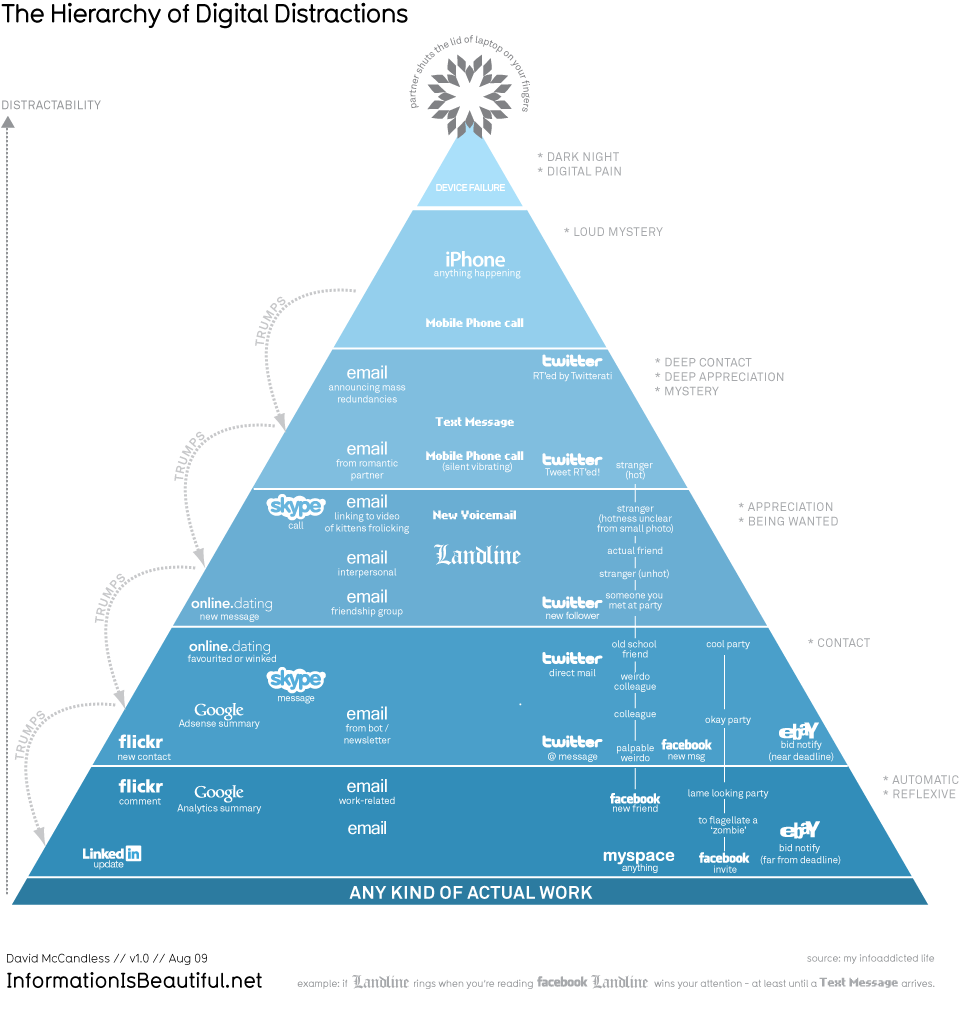
Hooked on Gadgets, and Paying a Mental Price

NY Times Thinks the gadgets are dumbing em down... you are correct.
...the effects of the deluge of data. Even after he unplugs, he craves the stimulation he gets from his electronic gadgets. He forgets things like dinner plans, and he has trouble focusing on his family. His wife, Brenda, complains, "It seems like he can no longer be fully in the moment." 

This is your brain on computers. 

Researchers say there is an evolutionary rationale for the pressure this barrage puts on the brain. The lower-brain functions alert humans to danger, like a nearby lion, overriding goals like building a hut. In the modern world, the chime of incoming e-mail can override the goal of writing a business plan or playing catch with the children.
"Throughout evolutionary history, a big surprise would get everyone's brain thinking," said Clifford Nass, a communications professor at Stanford. "But we've got a large and growing group of people who think the slightest hint that something interesting might be going on is like catnip. They can't ignore it."

...researchers were unsure whether the muddied multitaskers were simply prone to distraction and would have had trouble focusing in any era. But she added that the idea that information overload causes distraction was supported by more and more research.

...multitaskers took longer than non-multitaskers to switch among tasks, like differentiating vowels from consonants and then odd from even numbers. The multitaskers were shown to be less efficient at juggling problems.

Other tests at Stanford, an important center for research in this fast-growing field, showed multitaskers tended to search for new information rather than accept a reward for putting older, more valuable information to work.

The results also illustrate an age-old conflict in the brain, one that technology may be intensifying. A portion of the brain acts as a control tower, helping a person focus and set priorities. More primitive parts of the brain, like those that process sight and sound, demand that it pay attention to new information, bombarding the control tower when they are stimulated.

Read on at NY Times

NOTE 2 SuperTechs:
research shows some people can more easily juggle multiple information streams. These "supertaskers" represent less than 3 percent of the population, according to scientists.

Anonymous proxy server who is running it? And why?

FYI newbies-  Many technologies that amateur anonymity fetishists are attracted to are actually designed to harvest information.
HTML clipboard 20090530newbie.jpg
If you wanted a concentrated haul of the most interesting information what would you do?
You would establish a honeypot: a service (free or paid) that purported to provide an anonymous web browsing/email capability. Who knows what people might get up to if they thought nobody was looking? That, of course, is the idea with honeypots.

Cryptogon - Nerds with too much time on their hands get up to all kinds nonsense.
Do they set up anonymous proxy servers and open base stations just to see what people do with them? Yes.
Do criminals do it to find out personal information about you? Yes.

So even if the proxy or base station you're on isn't run by the NSA, who is running it? And why?

High-Traffic Colluding Tor Routers in Washington, D.C., and the Ugly Truth About Online Anonymity It's an old essay, but it has held up remarkably well.

Wired WikiLeaks, the controversial whistleblowing site that exposes secrets of governments and corporations, bootstrapped itself with a cache of documents obtained through an internet eavesdropping operation by one of its activists, according to a new profile of the organization's founder.

The activist siphoned more than a million documents ... supposedly stolen by Chinese hackers or spies who were using the Tor network to transmit the data, were the basis for WikiLeaks founder Julian Assange's assertion in 2006 that his organization had already "received over one million documents from 13 countries" before his site was launched, according to the article in The New Yorker.

Only a small portion of those intercepted documents were ever posted on WikiLeaks, but the new report is the first indication that some of the data and documents on WikiLeaks did not come from sources who intended for the documents to be seen or posted. It also explains an enduring mystery of WikiLeaks' launch: how the organization was able to amass a collection of secret documents before its website was open for business.

Tor is a sophisticated privacy tool endorsed by the Electronic Frontier Foundation and other civil liberties groups as a method for whistleblowers and human rights workers to communicate with journalists, among other uses. In its search for government and corporate secrets traveling through the Tor network, it's conceivable that WikiLeaks may have also vacuumed up sensitive information from human rights workers who did not want their data seen by outsiders.

The interception may have legal implications, depending on what country the activist was based in.
In the United States, the surreptitious interception of electronic communication is generally a violation of federal law..." Read more from
Wired

Wonder why nothing is getting done? Just checking...